
Can a Mayor Digitize a District?
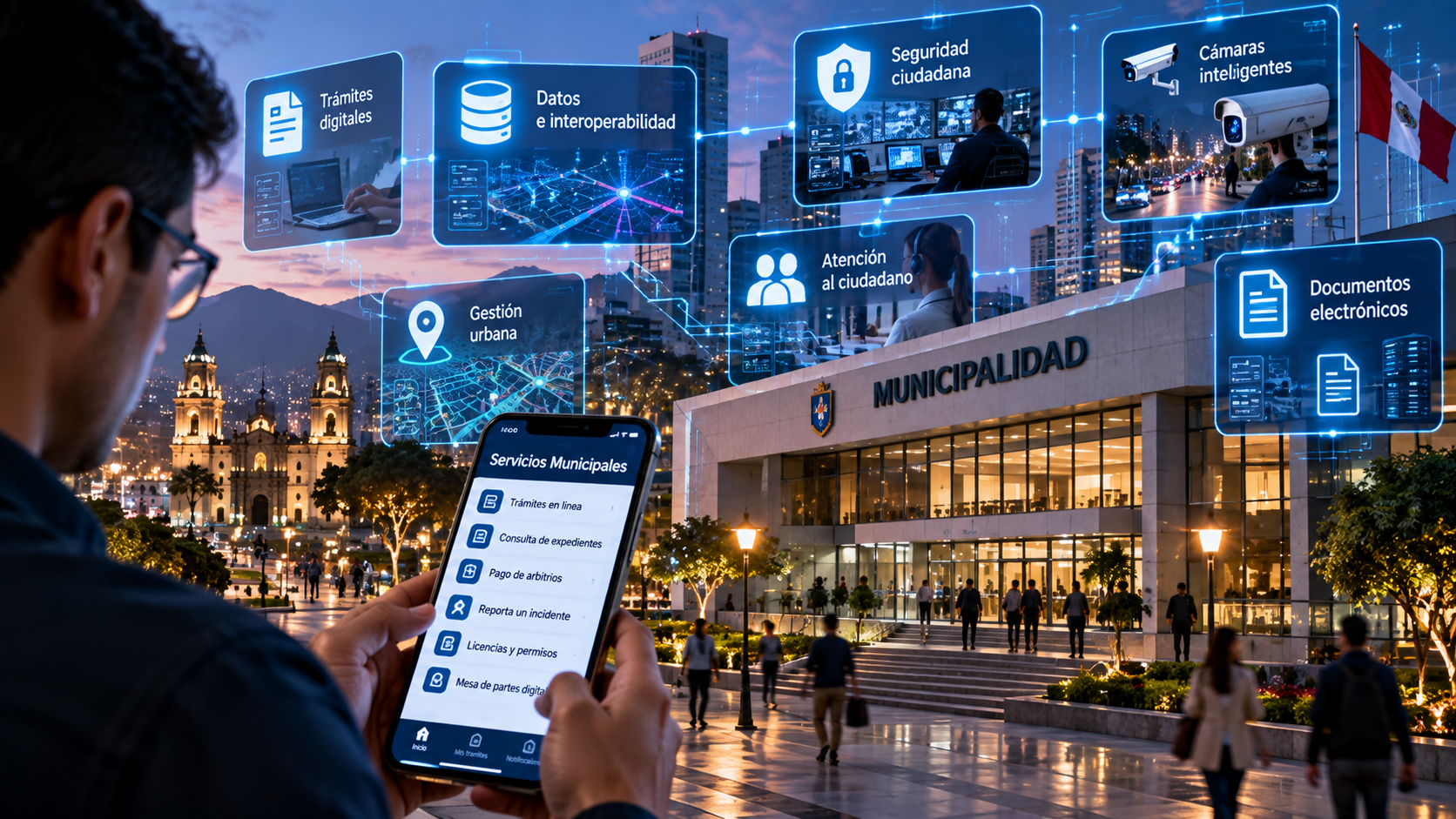
Municipal apps, digital procedures, artificial intelligence, connected cameras and citizen platforms are increasingly associated with modern cities. But does a mayor actually have the power to implement all of this?
The answer is yes, but with important limitations.
Peruvian local governments can digitize many processes, improve citizen services, integrate systems, use data and develop technology projects. Peru's Digital Government Law provides a framework for digital services, interoperability, cybersecurity and data management throughout the country's public administration.
There is, however, an important difference between digitizing a municipality and claiming that an entire district can be digitized by its mayor.
A mayor does not control every service in a district
Municipalities manage specific public responsibilities.
They can modernize areas such as permits, citizen requests, municipal inspections, local security operations, document management, urban information and certain local public services.
But other areas involve provincial, regional or national authorities.
Peru's Organic Law of Municipalities establishes different responsibilities for provincial and district municipalities. It also provides that mayors direct municipal plans and submit budgets and proposals, while municipal councils approve instruments including the annual budget.
In practical terms:
a mayor can lead digital transformation, but cannot implement every project through a unilateral decision.
A municipal app is entirely possible
Municipal digital services are technically feasible.
Citizens can potentially complete procedures online, track documents, receive electronic notifications, report local problems or access municipal information without visiting an office.
But municipalities do not necessarily need to build everything from scratch.
Peru already has public digital infrastructure available to government institutions.
The State Interoperability Platform, for example, allows public entities to exchange information electronically and is already used by more than 450 national, regional and local government entities.
The government also provides mechanisms for electronic document submission and other digital services.
Sometimes innovation is not about launching another app.
It is about using existing infrastructure properly.
Digital transformation is not software procurement
This distinction matters.
Peru's official framework for implementing digital government includes establishing a Digital Government and Transformation Committee, defining a digital strategy, implementing document management, interoperability, open data, information security, incident response and data governance.
Behind a simple screen on a citizen's smartphone must therefore be processes, databases, cybersecurity, responsibilities and long-term maintenance.
A municipality can purchase excellent software and still fail to transform its services.
If the original process remains unnecessarily complicated, the result may simply be:
digital bureaucracy.
Peru is already moving in this direction
This is not only theoretical.
In 2026, Peru's Municipal Management Improvement Incentive Program introduced a commitment aimed at helping 107 municipalities simplify and digitize procedures.
Individual municipalities are also developing strategies. The Provincial Municipality of Barranca launched a 2026–2028 Digital Government Plan designed to guide institutional modernization and improve municipal services and internal processes.
The important conclusion is straightforward:
municipal digital transformation is technically possible in Peru.
The real question is how it will be implemented.
How can a technology proposal be examined?
Whenever a municipal proposal mentions artificial intelligence, apps, smart cameras or digital platforms, several factual questions can help determine how developed the proposal actually is:
What specific problem will it solve?
Is it within the municipality's legal responsibilities?
Is there funding and infrastructure available?
How will it connect with existing government systems?
Who will operate, secure and maintain it once it launches?
When those questions have concrete answers, there is the foundation of a technology project.
When only the name of the technology exists, significant design work still remains.
Real transformation does not begin with an app
A mayor can absolutely lead a more digital municipality.
Local governments can simplify procedures, connect systems, use data, automate processes and adopt new technologies.
But municipal digital transformation should not be understood simply as the number of applications launched, screens installed or artificial-intelligence projects announced.
A much simpler measure matters to citizens:
Did technology allow them to solve their problem faster and more effectively?
That is where a truly digital municipality begins.