
Smart City or Just Hype?
AI-powered cameras, municipal apps, smart traffic lights and monitoring centers sound impressive. But turning a district into a smart city requires much more than simply buying technology.
In recent years, the concept of smart cities has become increasingly common in Peru. The idea is attractive: use technology and data to improve public safety, traffic management, public services and the relationship between citizens and their local governments.
The concept is not new to the Peruvian government either. Peru's Presidency of the Council of Ministers has promoted smart-city and digital-territory initiatives in which technology and data are expected to support better public decisions and services.
But there is a more difficult question:
Can a mayor actually transform a district through technology?
The short answer is yes.
But buying cameras or launching an app is not enough.
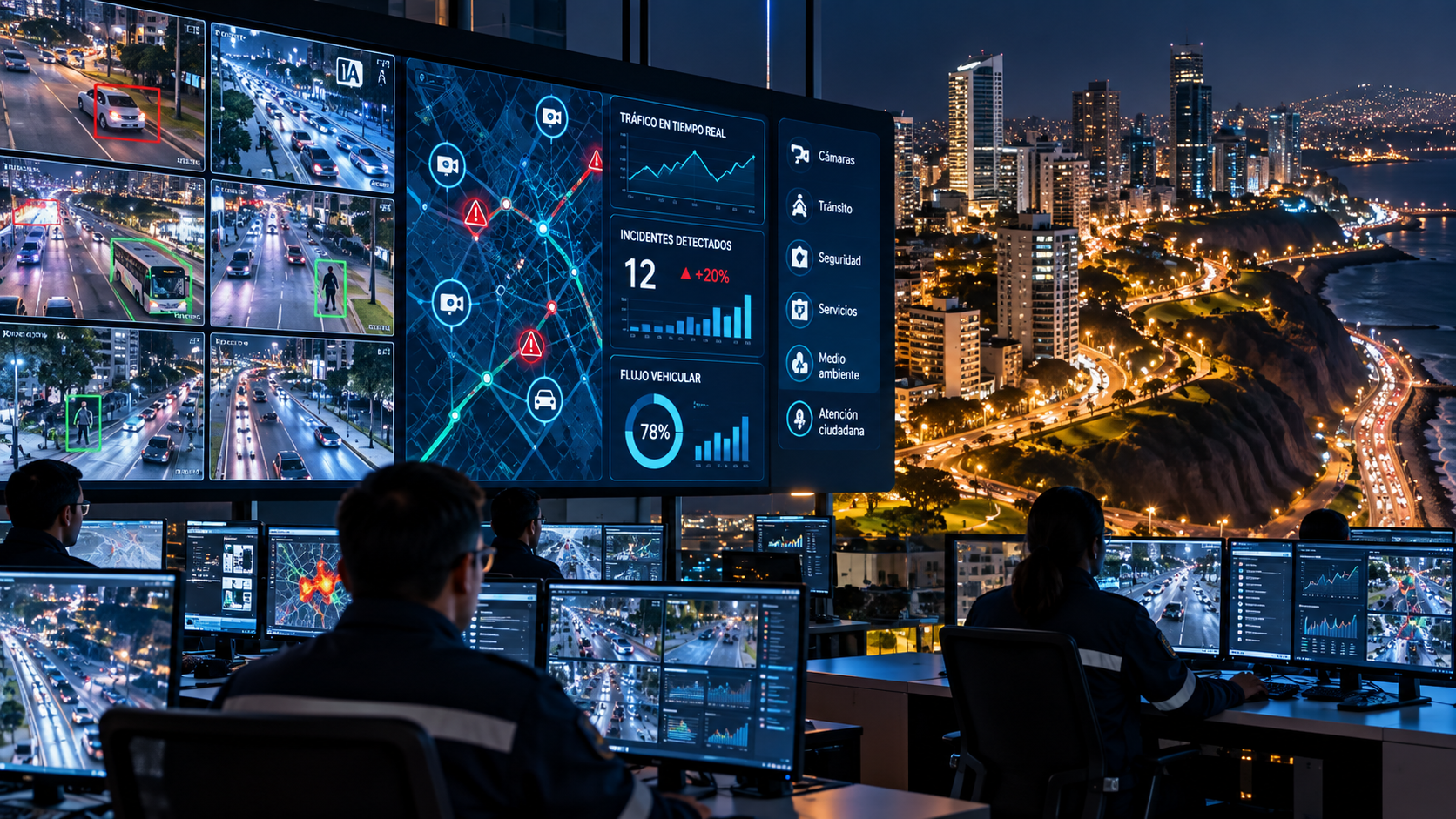
Cameras do not make a city smart
One of the most common misconceptions is that a smart city is simply a city filled with technology.
Surveillance cameras, sensors and monitoring screens can certainly be useful. The real transformation begins when those devices generate information that can be used to make better decisions.
Imagine a municipal system where cameras detect an incident, information is automatically connected to geographic data, security officers receive an alert and the municipality later analyzes where and when incidents occur most frequently.
At that point, we are no longer talking only about cameras.
We are talking about data, integration and automation.
Peru already has some of the infrastructure required to make this possible. The country's State Interoperability Platform allows public institutions to exchange information electronically and is used by more than 450 national, regional and local government entities.
Can a mayor implement this technology?
Yes, although there is an important limitation:
not everything is controlled by a district mayor.
Municipal responsibilities are established by law, and some projects require coordination with provincial governments or other public institutions.
Traffic management provides a good example.
Peru's Organic Law of Municipalities assigns provincial municipalities responsibilities that include organizing and maintaining traffic-light and signaling systems and regulating urban traffic.
A technological proposal may therefore be technically feasible while still depending on legal authority, funding, institutional coordination and operational capacity.
Lima currently provides an example of the scale these projects can reach. In March 2026, the Metropolitan Municipality of Lima announced a project involving approximately US$150 million to deploy smart traffic-light technology at nearly 500 intersections, linked to a metropolitan monitoring center.
The real challenge is behind the screen
Cameras, sensors, applications and control rooms are the visible elements of a smart city.
Behind them, however, there must be something far less glamorous:
well-structured databases, interoperable systems, secure infrastructure, skilled professionals, clearly defined processes, maintenance and long-term funding.
And this may be the biggest challenge.
Buying technology is often considerably easier than building an organization capable of operating it effectively for years.
A municipal application may eventually be abandoned. One platform may be unable to communicate with another. Cameras may collect enormous amounts of information that nobody analyzes.
The technology exists.
Managing it is the difficult part.
Peru is building the foundations
In 2026, Peru also approved its National Data Governance Strategy 2026–2030, designed to improve how government information is organized, governed and securely exchanged across national, regional and local institutions.
This matters because a real smart city depends on something that gets far less attention than artificial intelligence:
good data.
Without reliable, integrated and updated information, even the most advanced AI system will struggle to generate useful results.
Smart city or just hype?
Municipal technology is absolutely possible in Peru.
Public digital infrastructure already exists, several projects are underway, interoperability platforms are available and national strategies are encouraging further transformation.
But there is a major difference between buying technology and transforming a city through technology.
So whenever we hear proposals involving smart cameras, artificial intelligence, municipal apps or sophisticated control centers, perhaps the first question should not be:
“What technology are you going to install?”
A much better question is:
“What problem will it solve, what data will it use, and who will keep it running?”
That is where a truly smart city begins.