
Promising an App Is Not Innovation
Municipal apps, artificial intelligence, connected cameras, platforms for reporting incidents and government procedures from a smartphone.
Whenever public-sector modernization is discussed, technology proposals often focus on something citizens can immediately see:
an app.
But there is a problem.
Having an application does not necessarily mean an institution has been digitized.
And it certainly does not mean it has been transformed.
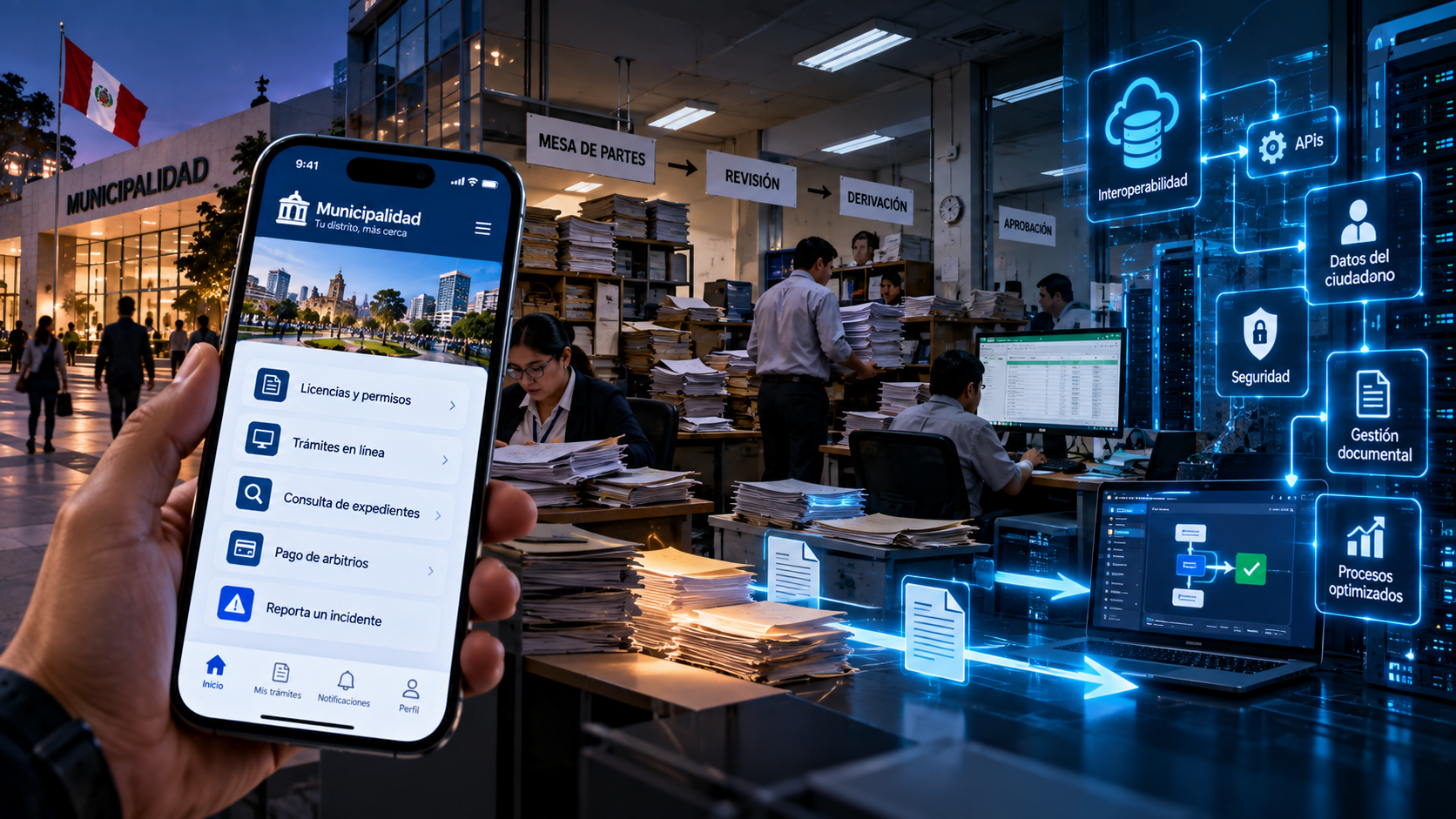
The app is only the front door
Imagine a municipality launches an application for requesting a permit.
A citizen enters their information, uploads the required documents and taps "Submit."
Everything appears digital.
But what happens if someone inside the municipality prints that request, physically moves it between offices, manually enters the same information into another system and eventually records the result in a spreadsheet?
Was the procedure really digitized?
Probably only its entry point was.
The underlying process remained essentially unchanged.
That illustrates an important distinction:
digitizing a screen is not the same as digitizing a process.
Peru's digital government framework goes much further
Peru's official digital-government framework makes clear that public-sector digital transformation involves considerably more than developing websites or applications.
The Presidency of the Council of Ministers identifies responsibilities involving digital planning, document management, interoperability, open data, information security, incident response and data governance, among other capabilities.
Peru's Digital Architecture Framework also seeks to coordinate information systems, data, infrastructure and security so that public services can operate as an integrated ecosystem.
In other words:
a good app is the part citizens see.
Much of the transformation happens behind it.
Why does interoperability matter?
Consider a simple question.
If one government institution already has certain information about a citizen, why should another institution require that person to submit the same document again?
Interoperability is designed to reduce that problem.
Peru's State Interoperability Platform provides infrastructure for secure electronic information exchange between public institutions and is already used by more than 450 entities across national, regional and local government.
This changes the meaning of innovation.
An attractive application that requires citizens to repeatedly enter information the government already possesses may look modern.
A system capable of securely retrieving the necessary information from another institution can provide a much more efficient service.
Innovation is not necessarily visible on the screen.
It may happen behind it.
Peru has made progress, but gaps remain
The OECD's latest Digital Government assessment provides useful context.
Peru scored 0.69 in the 2025 Digital Government Index compared with an OECD average of 0.70.
The country performed above the OECD average in areas including a data-driven public sector, user-driven services and digital-by-design approaches. However, it remained below the OECD average in Government as a Platform and especially in Proactiveness.
That helps explain the broader challenge.
Digital transformation is not simply about providing more digital services.
It is about making those services work together as part of an ecosystem.
An app also needs good data
There is another fundamental problem.
What happens when a modern application connects to outdated, duplicated or incomplete databases?
The user experience will still suffer.
In February 2026, Peru approved its National Data Governance Strategy 2026–2030, designed to improve the quality, security, governance and interoperability of information across public institutions.
The same principle applies to businesses.
You can deploy artificial intelligence.
You can build an impressive application.
You can purchase sophisticated software.
But if the underlying data and processes are poor, technology will inherit those problems.
Does that mean apps are useless?
Of course not.
A well-designed application can reduce waiting times, simplify procedures, improve communication and make services accessible from virtually anywhere.
The problem begins when the application becomes the objective.
An app should be a tool.
The objective should be solving a problem.
The OECD's 2026 Digital Government Outlook emphasizes designing public services around people's needs, integrating services so citizens do not have to navigate multiple agencies unnecessarily, and evaluating whether digital investments actually produce the expected results.
That distinction changes the conversation.
Instead of asking:
"What app will you build?"
we could ask:
"What problem will disappear when this technology works?"
Innovation you cannot always see
Real digital transformation may be less spectacular than we imagine.
A properly designed database.
Two institutions exchanging information automatically.
A procedure that once took days being completed in minutes.
A citizen no longer being asked for information the government already holds.
A system eliminating five unnecessary steps.
None of these necessarily produces an impressive launch photograph.
But they may matter far more than adding another icon to a smartphone.
Innovation is not simply placing technology in front of an existing process.
It is using technology to change that process.
And that is why promising an app is not the same as promising innovation.