
A digital ticket. A QR code. Reinforced public transport. Offline maps. Mobile networks under pressure. More than one million people attempting to reach the same place.
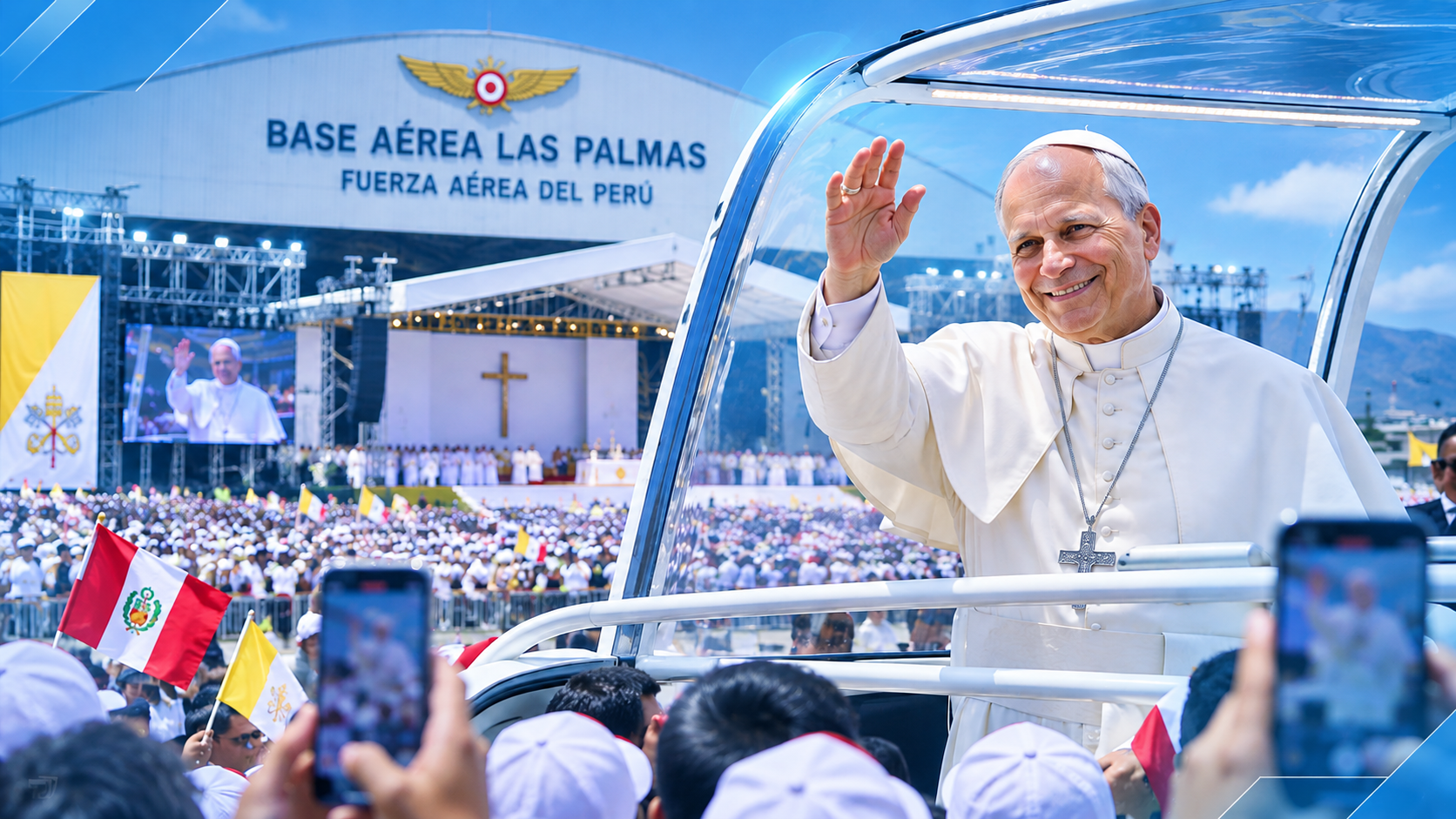
The Mass concluding Pope Leo XIV's visit to Peru on November 16 at Las Palmas Air Base will not only be a massive religious gathering.
It will also be an enormous technology test for Lima.
Recent estimates suggest attendance could range from at least 1.2 million to more than 1.5 million people. Access is free, but every attendee must obtain a personal, non-transferable Ticketmaster ticket linked to an identity document.
For several hours, Las Palmas will face many of the same challenges as a city: mobility, security, connectivity, identification, information, medical services, crowd movement and millions of digital interactions.
A QR code is more than a ticket
The digital ticketing system does more than provide admission.
Each ticket is associated with a specific person. Attendees receive an assigned access zone, entrance and recommended arrival time, while the QR code is checked together with the registered identity document.
From a technology perspective, this accomplishes something fundamental:
people begin being distributed before they even arrive.
If one million attendees attempted to enter through the same gate at the same time, no physical infrastructure could handle the demand.
Data begins organizing the event long before the gates open.
What happens when one million phones connect?
Imagine hundreds of thousands of people simultaneously sending messages, uploading photographs, streaming video, checking maps, searching for transportation and calling relatives.
Mobile infrastructure has finite capacity.
That is why attendees are being encouraged to save their QR codes before arriving, download offline maps and prepare alternative communication methods if mobile-data networks become congested.
It creates an interesting paradox.
We have more technology than ever before, yet large-scale events also require technology that can continue working when connectivity becomes limited.
Lima has to move as well
The challenge does not end at the gates.
Everyone has to get there.
And eventually everyone has to leave.
Public transport will operate with additional buses and reinforced Metro, Metropolitano and corridor services, together with extended schedules.
The logistical challenge therefore becomes an information challenge.
Where is demand increasing? Which station is becoming overloaded? Which entrance is receiving too many people? Where is additional transport required? Where has an emergency occurred?
Real-time information can dramatically improve those decisions.
A temporary city
For several hours, Las Palmas can effectively be understood as a temporary city.
It will require access control, transportation, water, medical services, security, communications, orientation and evacuation routes.
Future events could potentially combine offline-capable ticket validation, personalized digital maps, congestion alerts, real-time transportation information, crowd-density monitoring, integrated emergency dashboards and predictive systems designed to identify bottlenecks before they become dangerous.
Most of these technologies already exist.
The challenge is integration.
When data becomes a decision
Consider a simple situation.
A system detects that one entrance is receiving people significantly faster than another.
That information can immediately trigger a response: redirect pedestrian flows, deploy more personnel, send an alert or reinforce transportation elsewhere.
This is what separates a technology system from a collection of devices.
The objective is not having more screens.
It is turning data into decisions.
What happens after the event?
The most interesting question may come after the Mass is over.
How did transportation flows behave? Which stations handled demand effectively? Where did congestion appear? Did distributed entrances work? Where did mobile connectivity struggle?
Those answers could help improve future concerts, sporting events, emergencies, festivals and major public gatherings.
They could even help cities operate better every day.
Smart cities appear when we need them
Smart Cities are often discussed as futuristic projects.
But when more than one million people have to move through the same city at roughly the same time, the discussion becomes very practical.
We need data, connectivity, real-time information, connected systems and faster decisions.
For several hours, Lima will need to behave like a smart city.
Pope Leo XIV's visit will end.
The technology question remains:
What can this massive urban experiment teach us about improving the city once everyone goes home?